Pbs Wont You Be My Neighbor Will It Air Again
| Mister Rogers' Neighborhood | |
|---|---|
 | |
| Too known every bit | Misterogers' Neighborhood (1968–1970) |
| Genre |
|
| Created by | Fred Rogers |
| Starring |
|
| Theme music composer | Fred Rogers |
| Opening theme | "Won't You lot Exist My Neighbor?" |
| Catastrophe theme |
|
| Composers |
|
| Country of origin | Us |
| Original languages | English; some episodes feature DVS via SAP |
| No. of seasons | 31 |
| No. of episodes | 912 (including specials) |
| Production | |
| Production locations | WQED Studios Pittsburgh, Pennsylvania |
| Camera setup | Unmarried camera (1968–1992), Multi-camera (1992–2001) |
| Running fourth dimension | 28 minutes |
| Production companies |
|
| Benefactor | American Public Television receiver |
| Release | |
| Original network |
|
| Picture format | NTSC |
| Audio format | Mono (1968–1989) Stereo (1989–2001) |
| Original release | February 19, 1968 (1968-02-19) [i] – August 31, 2001 (2001-08-31) [2] [3] |
| Chronology | |
| Followed by | Daniel Tiger'south Neighborhood |
Mister Rogers' Neighborhood (sometimes shortened to Mister Rogers ) is an American half-hr educational children's tv set series that was created and hosted by Fred Rogers. The series Misterogers debuted in Canada on October 15, 1962, on CBC Boob tube.[4] [5] In 1966, Rogers moved back to the United States creating Misterogers' Neighborhood (sometimes shown every bit MisteRogers' Neighborhood [ citation needed ]), afterward called Mister Rogers' Neighborhood, on the regional Eastern Educational Tv set Network (EETN, a precursor of today's American Public Goggle box). The U.s. national debut of the show occurred on February 19, 1968. It aired on NET and its successor, PBS, until August 31, 2001.
The serial is aimed primarily at preschool children ages 2 to 5, but it was labelled by PBS every bit "appropriate for all ages".[six] Mister Rogers' Neighborhood was produced by Pittsburgh, Pennsylvania public broadcaster WQED and Rogers' non-profit production company Family Communications, Inc., previously known as Pocket-sized Globe Enterprises prior to 1971; the company was renamed The Fred Rogers Company after Rogers' death (it has since been renamed once more to Fred Rogers Productions as of 2019).[7] [viii] In May 1997, the series surpassed Helm Kangaroo as the longest-running children'south television receiver series,[9] [ii] a record the series held until June 2003, when Sesame Street shell Mister Rogers' record. The series could be seen in reruns on nearly PBS stations until August 31, 2007,[10] when information technology began to be removed past diverse PBS stations, and was and so permanently removed from the daily syndicated schedule by PBS after August 29, 2008.
Eleven years after Mister Rogers' Neighborhood ended, PBS debuted an animated spin-off, Daniel Tiger'due south Neighborhood. A 50th-anniversary tribute show, hosted by actor Michael Keaton (who got his start on the bear witness), titled Mister Rogers: It's You I Like, premiered on PBS stations nationwide on March 6, 2018.[11]
History
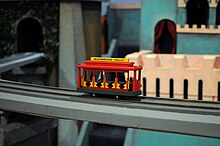
Neighborhood Trolley from Mister Rogers' Neighborhood set at WQED studios in Pittsburgh.
The serial had its genesis in 1953, when Rogers and Josie Carey joined the newly formed public television station WQED. On April 5, 1954, WQED debuted The Children'due south Corner, a program featuring Rogers as puppeteer and composer with Carey every bit host and lyricist, in an unscripted weekday afternoon alive television programme.[12] It was this program where many of the puppets, characters and music used in the subsequently series were developed, such equally King Friday Xiii, Daniel Tiger, and X the Owl. Information technology was also the time when Rogers began wearing his famous sneakers, as he institute them to exist quieter than his piece of work shoes while he was moving about behind the gear up. The show won a Sylvania Accolade[13] for all-time children's show, and was briefly broadcast nationally on the NBC Television Network.[fourteen] [fifteen] [16]
CBC Television receiver
Rogers moved to Toronto, Ontario, in 1961 to work on a new series based on The Children's Corner, chosen Misterogers, a 15-minute program on CBC Television.[17] Misterogers aired on CBC for almost four years and a number of the set pieces that he would take with him back to the United States, such as the trolley and castle, were created for the Canadian program by CBC designers and in collaboration with producer Bruce Attridge. Most chiefly, Rogers appeared on camera in the new prove rather than only appearing through puppets or characters. Fred Rainsberry, head of Children's Programming at CBC, persuaded Rogers to announced on camera in the new show (which he named later on Rogers) later on seeing him interact with children.[18] Ernie Coombs, i of the Americans whom Rogers brought with him to help develop the CBC show, would remain with CBC after Rogers returned to the United States. Coombs showtime appeared as Mr. Dressup in the CBC programme Butternut Square, conceived and produced past Attridge. Coombs so helped to develop what became Mr. Dressup which ran for nearly xxx years, ending in 1996.[xix]
Move to WQED
In 1966, Rogers caused the rights to his programme from CBC and moved the show to WQED in Pittsburgh, where he had worked on The Children'south Corner. He renamed the show Misterogers' Neighborhood, which initially aired regionally in the northeastern Us through EEN, including educational stations in Boston, Washington, D.C., and New York Metropolis.[19] The 100 episodes of the half-hour show incorporated the "Neighborhood of Brand-Believe" segments from the CBC episodes with additional reality-based opening and closing material produced in Pittsburgh. The series was cancelled in 1967 due to lack of funding, but an outpouring of public response prompted a search for new funding.
In 1967, The Sears Roebuck Foundation provided funding for the program, which enabled information technology to be seen nationwide on National Educational Tv set; taping began on September 21, 1967[20] [21] [22] for the offset national flavor. The first national broadcast of Misterogers' Neighborhood appeared on most NET stations on February nineteen, 1968. In 1970, when PBS replaced Cyberspace, it besides inherited this program. Around the same fourth dimension the show had a slight title change, to the more-familiar Mister Rogers' Neighborhood.
The bear witness was broadcast from February 19, 1968 to February twenty, 1976, and again from August 27, 1979 to August 31, 2001. The final episode was taped on Dec 1, 2000.[23] The studio at WQED in Pittsburgh where the series was taped was after renamed "The Fred Rogers Studio".
Format

Rogers on the gear up in the belatedly 1960s.
During each half-hour segment, Rogers speaks directly to the viewer well-nigh various topics, taking the viewer on tours of factories, demonstrating experiments, crafts, and music, and interacting with his friends. Rogers also made a point to merely behave naturally on photographic camera rather than acting out a grapheme, stating that "One of the greatest gifts y'all can requite anybody is the gift of your honest cocky. I as well believe that kids can spot a phony a mile away."[two] The half-hour episodes were punctuated past a puppet segment chronicling occurrences in the Neighborhood of Make-Believe. Another segment of the testify consisted of Rogers going to unlike places around the neighborhood, where he interviews people to talk about their work and other contributions that focused on the episode'southward theme, such equally Brockett's Bakery, Bob Trow's Workshop, and Negri's Music Shop. In one episode, Rogers took the prove behind-the-scenes on the set of The Incredible Hulk, which aired on CBS from 1978 to 1982.
At the start of each episode, the show's logo appears as the camera pans slowly over a model of the neighborhood, as the camera goes from the neighborhood to inside the Rogers' television set house. From 1979 to 1981, an alternate version of the opening sequence was used.[ which? ] Beginning in the early on 1980s, the neighborhood model incorporated a pocket-size version of the "Neighborhood Trolley", as it crosses several streets from left to right on a model train track. This is the same model electrical trolley that subsequently in the program will ship viewers into the Neighborhood of Make-Believe.[24] Usually, the camera goes from the neighborhood to out on the porch of the Rogers' television house, where the viewers see Fred Rogers coming for a visit earlier he enters the house. Afterward the photographic camera goes from the neighborhood to within the Rogers' television set house, Fred Rogers is seen coming home with his jacket on, singing "Won't You Exist My Neighbor?". He goes into the closet, takes off his jacket, hangs it up, and grabs a cardigan zipper sweater to put on. Later on that, he takes his wearing apparel shoes off and grabs a pair of blue sneakers to put on. One of Rogers' sweaters now hangs in the Smithsonian Institution, a attestation to the cultural influence of his simple daily ritual.[25]
At the terminate of each episode, Rogers sang "Information technology's Such a Good Feeling" (a dissimilar vocal, "Tomorrow" was used from 1968 to 1972) when he took off his sneakers as he says "You're live" in a higher toned voice, and grabs his wearing apparel shoes to put back on, then snaps his fingers two times. After that, Rogers goes into the closet, takes off his cardigan, hangs it upward, and grabs his jacket to put back on. Before the closing credits, Rogers got ready to go out the door by reminding the viewers: "You e'er make each mean solar day a special day. You know how: By but your being you lot/yourself. At that place'due south merely one person in the whole earth that's similar you, and that's yous. And people tin can like you lot merely/exactly the way you are. I'll be back next time. Bye-good day!". During the closing credits, which is complete with the show's logo and the episode number, the camera would perform a reversed version of the opening sequence's pan shot, while the "Neighborhood Trolley" crosses streets from right to left.
Starting in 1979, episodes were grouped into week-long series, with each series focused on a particular topic; each opening includes that weeks subject, in the form of "Mister Rogers Talks About [subject]". Rogers' monologues throughout the week explore various facets of the topic, and the ongoing story from the Neighborhood of Make-Believe serves as illustration.
Rogers covered a broad range of topics over the years, and the serial did not shy away from bug that other children'south programming avoided. In fact, Rogers endeared himself to many when, on March 23, 1970, he dealt with the expiry of one of his pet goldfish. The series also dealt with competition, divorce, and war. Rogers returned to the topic of anger regularly and focused on peaceful ways of dealing with angry feelings.
Beginning in the 3rd season, Mister Rogers always made a clear distinction between the realistic earth of his idiot box neighborhood and the fantasy world of Make-Believe (prior to that, the line was blurred somewhat as he would oftentimes talk near it as if information technology were real and he had a direct line of contact with the characters in it). He oftentimes discussed what was going to happen in Make-Believe earlier the next fantasy segment was shown ("Let's pretend that Prince Tuesday has been having scary dreams..."), and sometimes acted out bits of Brand-Believe with models on a table before the photographic camera transitioned to the live-action puppet rendition. The miniature motorized trolley, which was known in character grade as "Trolley", with its accompanying fast-paced piano theme music, and which was operated by Rogers working buttons and controls hidden on the side of the bench on which Rogers would unremarkably sit with his left hand, was the only element that appeared regularly in both the realistic world and Brand-Believe: it was used to ship viewers from ane realm to the other. Rogers, withal, was mentioned from time to time in Make-Believe, particularly by Mr. McFeely, who appeared occasionally in the Make-Believe segments and seemed to form a link between the two worlds. The idea of the trolley came from Rogers. When he was young, many trolleys operated in Pittsburgh, and he liked riding on them.[26] This reality/fantasy distinction put Rogers' serial in sharp contrast with other children's series, such as Sesame Street and Helm Kangaroo, which freely mixed realistic and fantastic elements.
Trolley was a character in its own right. Often when information technology crossed into the Neighborhood of Brand Believe, it would terminate and have a "conversation" with Rex Friday Thirteen (by moving dorsum and forth slightly and making bong noises to respond to Friday) then continue on. Trolley also truly showed the difference between the worlds during the week when the three youngest puppet characters (Daniel Striped Tiger, Prince Tuesday, and Ana Platypus) prepared for and went to school for the first time, as information technology played the school bus. When in Mister Rogers' firm, it simply had ii pieces of yellowish construction paper shaped and fatigued similar the profile of a school bus stuck to its sides, but in the Neighborhood of Brand-Believe, it had a chassis on it that made it look like a school autobus.
The series featured "Moving picture Pic", a rear-projection motion picture show and slide projector, whose screen is encased with a picture frame. In early episodes, Motion-picture show Motion picture would show various films or slides at Mister Rogers' command; after the cloth was presented, Mister Rogers would thank Moving picture Picture, to which information technology would return a "You're Welcome" on its screen. After 1970, Picture Flick no longer operated magically, becoming merely a projector; Mister Rogers would insert a pic, slides or videotape through a slot on the side, then evidence the material using a wired remote control (slides were viewed on Picture Motion picture; films and video were faded in to the prune). When Film Movie was non used, a different painting would be displayed on its screen. Often it would display the words "Hello" or "How-do-you-do" at the opening.
The series was also notable for its employ of jazz-inspired music, mostly bundled and performed by Johnny Costa, until Costa's death in 1996, when he was succeeded by Michael Moricz for the remainder of the series. The music was unique in its simplicity and catamenia that composite with the series' sketches and features. The music was commonly played alive during taping. Lyrics and melodies were written and sung by Rogers, who created more than 200 original songs.
Characters
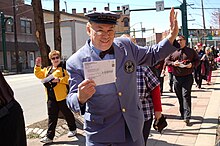
Mr. McFeely ("Speedy Delivery") leads a group to the post role to mitt-deliver their completed 2010 Census forms during the "Count Me In In 2010 Rally" in Homestead, PA.
Mister Rogers' Neighborhood
Characters on the series include:
- Neighbor Aber (Chuck Aber) - A resident of Westwood who is an associate of Mayor Maggie and does a lot of odd jobs. His existent world counterpart also does odd jobs.
- Lady Aberlin (Betty Aberlin) - The niece of King Fri XIII. Her real-world counterpart Betty is an actress who is the managing director of Betty's Fiddling Theater.
- Scientist Adler (Bud Adler) - A scientist who offers his scientific expertise in the existent earth and the Neighborhood of Brand-Believe in earlier episodes.
- Charles Appel - A teacher and sorcerer who is a friend of Mr. Rogers.
- Natalie Baker - The cousin of Joe Negri and mother of Angela and Reid who is a piano-playing instructor.
- Marilyn Barnett - The gym teacher at the neighborhood school.
- Chef Brockett (Don Brockett) - A baker who owns Brocket's Baker. His Neighborhood of Brand-Believe counterpart assists Edgar Cooke in the kitchen.
- Bob Brownish - A puppeteer and marionette maker who is proprietor of Bob'southward Marionette Theater which is side by side door to Mr. Rogers' house.
- Judy Brown - The wife of Bob and co-proprietor of Bob's Marionette Theater.
- Michael Brownish - The son of Bob and Judy Dark-brown.
- Tony Chiroldes - The proprietor of the shop "Tony'south" which specializes in toys, books, and costumes.
- Jose Cisneros - An employee at Brocket'due south Bakery and cousin of Gladys Schenk who operates the counter and soda store. He started working at Brocket Baker after Gladys had a infant.
- Officer Clemmons (François Clemmons) - A police officer who is a trained opera singer.
- Dr. David Crippens - The neighborhood doc.
- Keith David - In the Neighborhood of Make-Believe, he is a carpenter who lives in Southwood. His real world counterpart appears in episode 1514 where he collects the money from the Donkey Kong arcade game at Brockett'due south Bakery.
- Emily the Poesy Lady (Emily Jacobson) - She appeared in early episodes.
- Joey Hollingsworth - A tap dancer who shares his talents in the "existent" world and the Neighborhood of Brand-Believe.
- Pilot Ito (Yoshi Ito) - An opera vocalizer who serves as the majestic pilot of King Fri Thirteen.
- Susan Linn - A local puppeteer who often makes up stories that involve Audrey Duck and Catalion at Betty'southward Little Theater.
- Mayor Maggie (Maggie Stewart) - The Mayor of Westwood. Her existent world counterpart Maggie is an practiced at sign language.
- Mr. McFeely (David Newell) - The delivery man for "Speedy Delivery" who was a frequent company to Mr. Rogers' firm. He was named for Fred Rogers' maternal grandad.[27]
- Mrs. McFeely (Betsy Nadas) - The married woman of Mr. McFeely.
- Elsie Neal - A woman who operates the neighborhood arts and crafts and costume shop.
- Debbie Neal - The daughter of Elsie Neal and an excellent singer who works at Negri's Music Shop.
- Handyman Negri (Joe Negri) - A jazz-guitarist who has taught music at several Pittsburgh universities. His real world analogue Joe operates the musical-instrument shop called Negri's Music Shop on Rogers's street.[28]
- Miss Paulificate (Audrey Roth) - The royal phone operator. Her real-world counterpart Audrey operates a janitorial service called Audrey Cleans Everything, where her mobile home serves as her role.
- Sergio Pinto - An employer at Brockett's Bakery who runs the counter and would teach some Castilian words to Mr. Rogers.
- Mary Rawson - She shows interest in the theater and mime at "Betty'south Little Theater."
- John Reardon - An opera singer and frequent visitor of the Neighborhood of Make-Believe who helps its residents write and perform various operas.
- Gladys Schenk - A mother of ii and an employee at Brockett's Bakery and cousin of Jose Cisneros.
- Chrissy Thompson - The granddaughter of Mr. McFeely and Mrs. McFeely. She has spina bifida which requires her to use leg braces and openly talks near it.
- Bob Trow - He runs Trow's Workshop where he works as a craftsman. It is at Trow's Workshop that Bob creates and fixes things for Mister Rogers and his fellow neighbors.
- Jewel Walker - A mime creative person.
Merely Mr. McFeely, Mrs. McFeely, Officeholder Clemons, Scientist Adler, and Chef Brockett appeared substantially the same way in both Mr. Rogers' Neighborhood and the Neighborhood of Make-Believe.
Neighborhood of Brand-Believe
The "Neighborhood of Make-Believe" is the fictional kingdom visited by Mr. Rogers during the show. Characters in the Neighborhood of Brand-Believe were portrayed by both manus puppets and actors. Fred Rogers was the puppeteer for a bang-up number of the characters:
- Collette
- Cornflake Due south. Pecially
- Daniel Stripèd Tiger
- Donkey Hodie
- Edgar Cooke
- Grandpère Tiger
- Henrietta Pussycat
- Ino A. Horse
- King Friday XIII
- Lady Elaine Fairchilde
- Mrs. Frogg
- Princess Margeret H. Lizard
- Queen Sara Saturday
- Tadpole Frogg
- X the Owl
Other characters and their performers or puppeteers:
- Anna Platypus
- Betty Okonak Templeton-Jones
- Bob Dog
- Cousin Mary Owl
- Cousin Steven Owl
- Dr. Duckbill Platypus
- Elsie Jean Platypus
- Harriett Elizabeth Moo-cow
- H.J. Elephant III
- Hula Mouse
- James Michael Jones
- Prince Tuesday
- Imperial Panda
- Robert Troll
In addition to Bob Trow other regular puppeteers included Michael Horton, Lenny Meledandri (1980–2001), and Carole Switala.
Michael Keaton made his first boob tube appearance as a volunteer in 1975. He played an acrobat in a troupe called The Flying Zookeenies that performed for King Friday'southward birthday and was also in accuse of running the Trolley.[29]
Operas
Thirteen in-series "operas" took place during the course of the serial inside the Make-Believe segments.[27] Many of them featured American baritone John Reardon as a main character. The operas would cover the entire episode and would be seen after a brief introduction by Mr. Rogers.
- Babysitter Opera (1968)
- Campsite Opera (1968)
- Teddy Conduct/Whaling Ship Opera (1969)
- "Pineapples and Tomatoes" (1970)
- "Monkey's Uncle" (1971)
- "Snow People and Warm Pussycat" (1972)
- "Potato Bugs and Cows" (1973)
- "All in the Laundry" (1974)
- "Primal to Otherland" (1975)
- "Windstorm in Bubbleland" (1980)
- "Spoon Mountain" (1982)
- "A Granddad for Daniel" (1984)
- "A Star for Kitty" (1986)
Additionally, a play, Josephine The Short-Necked Giraffe, first aired in 1989 as a tribute to the tardily John Reardon.
Guests
Guests on the series ranged from cellist Yo-Yo Ma to actor and bodybuilder Lou Ferrigno of Television receiver'south The Incredible Blob (in a 2001 piece where celebrities were asked about their heroes, Rogers cited Ma as one of his heroes[ citation needed ]). A 1968 visit by electronic music pioneer Bruce Haack resurfaced in the 2004 documentary Haack: Rex of Techno.
Guests on Mister Rogers' Neighborhood were often surprised to find that although Rogers was simply equally gentle and patient in life every bit on television receiver, he was nevertheless a perfectionist who did non allow "shoddy" advertising-libbing;[thirty] he believed that children were thoughtful people who deserved programming every bit good as annihilation produced for adults on television.[31]
Rogers appeared as a guest on another series. On the children's animated cartoon series Arthur, for case, Rogers plays himself as an aardvark like Arthur. After on, Arthur appears equally a guest in paw-boob form in a 1999 episode of Mister Rogers' Neighborhood in the Neighborhood of Make-Believe. Bill Nye, host of a science-themed program, and Rogers as well exchanged appearances on each other's series, as did Rogers and Captain Kangaroo. Rogers additionally appeared in an episode of Sesame Street, where he explains to Large Bird that fifty-fifty if 1 loses a running race such as the one Big Bird had run against his friend "Snuffy", no hard feelings threaten to break the two of them apart.[32] Big Bird himself as well appeared in one episode of Mister Rogers' Neighborhood in the Neighborhood of Make-Believe when he came to deliver his entry to the "Draw the Neighborhood" art contest.
Funding
- Due north.E.T. affiliated stations children's plan fund (1968–seventy)
- The Sears-Roebuck Foundation (1968–76, 1979–92)
- Corporation for Public Broadcasting (1971–76, 1991–2001)
- Bureau of Education for the Handicapped (1975)
- Ford Foundation (1975–76)
- Johnson & Johnson (1975–76)
- Office of Instruction (1974–75)
- Public Television Stations / "contributions to your PBS station from Viewers Like Y'all" (1975–76, 1979–2001)
The Ford Foundation, Public Television Stations and Johnson & Johnson likewise provided funding for repeats of the 1969-1975 colour episodes, beginning in 1976.
Afterwards the series
When Fred Rogers died in 2003, PBS's website provided suggestions to parents on how to respond to children who inquire about Rogers' decease.[33]
Commencement on September iii, 2007, some PBS affiliates began replacing the show with new programs such equally Super Why!, WordGirl and WordWorld. In June 2008, PBS announced that, commencement in tardily 2008, the network would finish dissemination Mister Rogers' Neighborhood as office of its daily syndication lineup to member stations, instead airing the program just once a week over the weekend.[34] Milwaukee PBS, for example, still carries the bear witness once a week, on Sunday, over its main HD/SD channel.[35] Beginning on September 1, 2008, Mister Rogers was replaced by new programming such every bit Martha Speaks, Sid the Science Kid, and an update of The Electric Company. However, individual member stations have the choice of airing Mister Rogers independently of the PBS syndicated feed, with series domicile WQED in detail continuing to air the series daily until 2010.[36] There was a campaign in 2008 and 2009 to urge PBS and all member stations to bring the show back seven days a week.[37]
To celebrate the 50th anniversary of the series' national premiere, PBS aired select episodes of Mister Rogers' Neighborhood for a calendar week in February 2018.
Spin-offs
In July 2011, during the annual Television Critics Association summertime press bout, it was announced that a new animated spin-off series, Daniel Tiger's Neighborhood, was in production. The show debuted on most PBS stations on September three, 2012. The series features Daniel Tiger, the four-year-old son of Daniel Striped Tiger, as a host of the serial, which also features characters of the Neighborhood of Make-Believe all grown older, with the children now having families of their ain.[8] [38]
A 2nd spin-off titled Donkey Hodie, focusing on the titular grapheme, aired on PBS May 3, 2021. The puppet series features a radically dissimilar blueprint for the grapheme along with his friends Royal Panda, Duck Duck and Bob Dog, as they larn and sing through the land of "Someplace Else".[39] [40]
Music and regular songs
Regular songs
The song "Won't Y'all Be My Neighbor?" was written by Fred Rogers in 1967 and was used as the opening theme for each episode of the show.
In the first three seasons of the show, during which new episodes were constantly being produced, each evidence ended with the song "Tomorrow", which was written by Rogers' former colleague, Josie Carey. Starting with Season iv in 1971,[ citation needed ] "Tomorrow" was used only on Monday through Thursday episodes, and a new closing vocal, which is titled as "The Weekend Song", was used only on Friday episodes as the plan would non return until Monday.
Eventually, the "Tomorrow" song was removed entirely due to copyright issues, and by 1973, Rogers sang "Information technology's Such a Expert Feeling" at the finish of each episode. Prior to 1973, the original version of "It'due south Such a Skillful Feeling" was used as role of Mister Rogers' general repertoire of songs. When "It'due south Such a Expert Feeling" became the closing theme for Mister Rogers' Neighborhood in 1973, it used a rewrite of "The Weekend Vocal" at the cease, using only the first 4 lines: "And I'll be back when the day is new, and I'll take more than ideas for y'all. And you'll have things yous'll want to talk about; I will likewise". This was only used on Monday through Thursday episodes. On Friday episodes, the lyric was changed to "week" instead of "solar day". On early on episodes of this flavour, the line was originally written as "When tomorrow is new".
Music
Musical directors for the serial include:
- Johnny Costa (1968–96)
- Michael Moricz, who took over as music director after Costa's death and served until the cease of the series in 2001.
In addition to arranging and directing the music heard on Mister Rogers' Neighborhood, Costa, along with other musicians, performed most all the background music heard on the serial, including the show'south recognizable main theme, the trolley whistle, Mr. McFeeley'south frenetic speedy commitment pianoforte plonks, the vibraphone flute-toots (played on a synthesizer) as Fred fed his fish, dreamy celesta lines, incidental music, and Rogers' entrance and exit tunes. Each mean solar day an episode was taped, Costa and his ensemble played alive in the studio for the filming. Musicians who played in this ensemble were:
- Johnny Costa – Pianoforte, Celesta, Synthesizer, & Trolley Whistle
- Joe Negri – Guitar
- Carl McVicker Jr. – Double Bass
- Bobby Rawsthorne – Drums & Percussion[41] [42]
Even after Costa's death in 1996, much of the music heard on the plan continued to be Costa'southward and his name continued to be listed in the prove's endmost credits equally 1 of its Musical Directors.[43]
Broadcast history
The first broadcast of Mister Rogers' Neighborhood was on the National Educational Television network on Feb 19, 1968; the color Net logo appeared on a model building at the beginning and cease of Mister Rogers' Neighborhood from 1969 to 1970. When Cyberspace ceased operations, the series moved its successor network PBS, even though episodes up until the end of the fourth flavor in May 1971 were still copyrighted past and produced for Net.[44]
The series' kickoff flavor (1968) consisted of 130 episodes, produced in black-and-white. For seasons two–viii (1969–75), the evidence produced 65 new color episodes each twelvemonth. By the end of season 8, this meant at that place was a library of 455 color episodes which could be repeated indefinitely. Rogers and the rest of the prove's cast and coiffure began suffering burnout from taping 65 episodes a year and in 1975, Rogers made the decision to take a break from the serial for a few years. As a issue, season 9 (1976) consisted of only 5 episodes. These five new episodes (which aired the last calendar week of original episodes of the so-called "first series") featured Mister Rogers in his workshop, watching scenes of past episodes of his series, which he recorded on videocassettes and kept on the shelf in his workshop. On the Friday episode of that calendar week (February twenty, 1976), he reminded viewers that they, also, could watch many of those one-time episodes beginning the following week. During the hiatus period, two primetime episodes were produced and aired as specials: a Christmas show in December 1977 and a "springtime"-themed prove.
In 1978, production of the serial resumed, with an eye towards "freshening upward" the bear witness by producing 15 new episodes per year. These "2nd series" episodes, which began ambulation in August 1979, would exist mixed in with the already-airing wheel of repeats from the so-called "first series" (i.due east., the color episodes of seasons 2–9, aired from 1969 to 1976).
The series aired xv new episodes annually between 1979 and 1993. As well, in that location were occasional "Mister Rogers Talks with Parents About..." specials, which featured panelists discussing ways in which parents could talk to their children about the problems discussed on Mister Rogers' Neighborhood. These specials were usually aired on weekends, merely prior to the airing of a new batch of Monday-to-Friday episodes.
Beginning in 1994, the product schedule was changed so that ten new episodes a yr were produced instead of fifteen. Shortly thereafter, as of Baronial 11, 1995,[ citation needed ] the episodes from the "showtime serial" (1968–76) were withdrawn from the repeat schedule, since at that place were over 200 "2nd serial" episodes available for circulate, and many of the first series episodes had become outdated.[ citation needed ] The evidence's last years varied the number of episodes produced per season: flavor 26 (1995–96) consisted of twenty episodes, season 27 (1997) produced 10 episodes, seasons 28 and 29 (1998–99) both independent xv episodes, and season 30 (2000) reverted to x episodes. The final season, flavour 31 (2001), consisted of only 5 episodes, centering on the theme "Celebrate The Arts".
A few episodes from the "offset serial" are available for viewing in the Paley Center for Media, including the first episode of the series and the outset color episode. A complete collection of episodes, including more than 900 videotapes and scripts from the show along with other promotional materials produced by Rogers or his Family unit Communications Inc. production company, exists in the University of Pittsburgh's Mister Rogers' Neighborhood Athenaeum located in the Elizabeth Nesbitt Room in the academy's School of Information Sciences Building.[45]
Reruns
When PBS began re-airing the first 460 colour episodes of the series in 1976, some of the earliest color episodes from 1969 and 1970 were re-edited with new phonation-overs or footage. For case, in ane 1970 episode where Mister Rogers demonstrates the noise-proof ear protectors that airport workers use on the tarmac, the movie footage used featured a worker directing a United Airlines jet with its stylized "U" logo—which was not introduced until 1974. All of the episodes revised from the first serial besides included an extra segment post-obit the closing credits, mentioning the episode number and boosted companies that provided funding since these episodes originally aired, even though they had not provided funding at the fourth dimension of original production the use of episode number correlated to an activeness guide for parents, which includes activities and discussion topics for parents and child care providers to use with their children.[46] The black and white episodes of the start flavor were last re-run on August 21, 1970, just before Cyberspace was replaced past PBS.
As of 2013[update], almost all of the 1979–2001 "2d serial" episodes are still in active rotation on a number of PBS stations.[47] [48] [49] The only exception is the week-long "Disharmonize" series (episodes #1521–#1525), first aired during the week of November 7–11, 1983. The series/story arc covered the topics of war, bombs, and an arms race, and was created in response to the Invasion of Grenada, and the 1983 Beirut barracks bombings.[ citation needed ] The "Conflict" series was final aired on PBS during the calendar week of April 1–5, 1996.[ citation needed ]
Only a few episodes of the series accept been released to DVD by Anchor Bay Entertainment, although some earlier compilation-based releases were issued on VHS past Playhouse Video during the mid-1980s. 100 episodes have subsequently been released every bit office of Amazon Video.[fifty] A DVD prepare titled the It's a Beautiful Twenty-four hour period Collection, containing xxx episodes from the 2nd series, was released on March 27, 2018 past PBS.[51] [52]
Twitch marathons
On May 11, 2017, streaming video platform Twitch announced with The Fred Rogers Company that 886 episodes of Mister Rogers' Neighborhood would be streamed live on the Internet over an eighteen-twenty-four hour period period (although several episodes were skipped over during the marathon, near notably the 1983 "Disharmonize" episodes).[53] The marathon began on May 15, 2017, at noon PT and ended on June three, 2017. The marathon included many Mister Rogers episodes that had only aired in one case before. During the live stream, viewers were encouraged to support their local PBS station.[53]
Mister Rogers' Neighborhood joined other popular PBS shows, including The Joy of Painting and The French Chef, that accept been streamed on the Twitch service.[53]
On March 20, 2018, Twitch began streaming a 90-episode marathon to commemorate Rogers' 90th birthday, followed by a repeat marathon of the series.[54] [55]
International Circulate
In the Canadian province of Ontario, the show was broadcast on TVOntario from 1970 to 1989. These broadcasts could as well be seen in US cities close to Canadian border.
Episodes
Specials
A prime number time Christmas special, Christmastime with Mister Rogers, first aired in 1977. This special had François Clemmons introducing a storyteller and flutist friend to Rogers. They filmed several narrated segments of the stories François' friend told. The special likewise had the Neighborhood of Brand-Believe segment which shows how they celebrated Christmas. The trolley had a imprint on the roof that said "Merry Christmas" on one side, and "Happy Hannukah" on the other. This special was aired every Christmas season until 1982. This special'due south opening and close have Rogers walking through a real neighborhood while the titles roll rather than the model neighborhood used in the series.
In 1994, Rogers created some other one-time special for PBS called Fred Rogers' Heroes which consisted of documentary portraits of 4 existent-life people whose work helped make their communities better. Rogers, uncharacteristically dressed in a suit and tie, hosted in wraparound segments that did not use the "Neighborhood" set.
For a time, Rogers produced specials for the parents equally a precursor to the subject of the week on the Neighborhood chosen "Mister Rogers Talks To Parents About [topic]". Rogers did non host those specials, though; other people like Joan Lunden, who hosted the "Disharmonize" special, and other news announcers played MC duties in front end of a gallery of parents while Rogers answered questions from them. These specials were fabricated to prepare the parents for any questions the children might ask after watching the episodes on that topic of the calendar week.
Mister Rogers: It'due south You I Like
On March 6, 2018, a primetime special commemorating the 50th anniversary of the serial aired on PBS, hosted by player Michael Keaton.[11] [56] The hour-long special likewise features interviews past musician Yo-Yo Ma, musician Itzhak Perlman, actress Sarah Silverman, actress Whoopi Goldberg, actor John Lithgow, screenwriter Judd Apatow, role player David Newell, producer Ellen Doherty, and spouse Joanne Byrd Rogers, as well as clips of memorable moments from the evidence, such every bit Rogers visiting Koko the gorilla, Margaret Hamilton dressing upward as The Magician of Oz's Wicked Witch of the West, and Jeff Erlanger in his wheelchair singing "Information technology'south You I Like" with Rogers.[57]
Earlier PBS specials include Our Neighbor, Fred Rogers in 1990 and Fred Rogers: America's Favorite Neighbor in 2003.[58] [59] [60] A short special, Mister Rogers in Our Neighborhood past PBS station WUCF, described Fred Rogers'southward college years and family connections in Florida.[61]
Tributes
Over the years, many television shows, exhibits and attractions accept been named in tribute to Mister Rogers' Neighborhood. After 3 years equally a traveling exhibit, the Children'due south Museum of Pittsburgh[26] had "Welcome to Mister Rogers' Neighborhood" installed every bit a permanent exhibit in 2004.[62] The planetarium show "The Sky In a higher place Mister Rogers' Neighborhood" is a figurer-animated adaptation of the boob tube prove for preschool-aged children.[63] Idlewild and Soak Zone, an amusement park near Rogers' hometown of Latrobe, Pennsylvania has an attraction called "Mister Rogers' Neighborhood of Make-Believe" featuring a life-size trolley ride, designed by Rogers. This was close down in 2014 to reopen every bit Daniel Tiger's Neighborhood in 2015.[64] [65] A children's play expanse at Monroeville Mall in the Pittsburgh suburb of Monroeville was named for the idiot box show.[66]
Many of the artifacts from the gear up of Mister Rogers' Neighborhood, including the tree of Ten the owl, the make-believe neighborhood and the inside entrance to Mister Rogers' abode is on brandish at the Heinz History Eye in Pittsburgh. Also included is a life-size effigy of Mister Rogers and a sweater he wore on the show.
A kiosk containing artifacts used during the serial is located on Concourse C of Pittsburgh International Airport, almost the children's play area.[67] The Mister Rogers' Neighborhood Archives at the University of Pittsburgh'due south School of Information Sciences is an academic resource and collection that contains correspondence, scripts, props, puppets, fan mail, 911 tapes including all only four episodes of the series on 3/4-inch production videotape; plus i on VHS (iii other episodes are not in the drove) forth with various videos of specials, interviews and scholarly articles that show the cultural impact of Fred Rogers' work.[68] A statue of Fred Rogers exists on the N Shore of the Allegheny River near Heinz Field at the surviving footing of the Manchester Bridge.[69] The original trolley from the shows is on brandish at the Canadian Dissemination Centre in Toronto, Ontario.[ citation needed ]
A documentary feature moving-picture show nigh the series, titled Won't You lot Be My Neighbor?, was released by Focus Features on June 8, 2018.[seventy] [1] [11] Some other documentary, Mister Rogers & Me, was shown at film festivals in 2010 and on PBS stations in 2012.[71] [72] An American drama film, titled A Beautiful Twenty-four hour period in the Neighborhood starring Tom Hanks as Rogers, was released on Nov 22, 2019 by TriStar Pictures.[73]
On September 21, 2018, a Google Doodle was created in award of Mr. Rogers.[74]
Music
The music of the show was interpreted by an eclectic mix of modernistic artists for the 2005 anthology Songs From the Neighborhood: The Music of Mister Rogers. The YouTube evidence Pittsburgh Dad uses a piano theme song inspired by the jazz music constantly heard on Mister Rogers' Neighborhood.[75] The musical project Symphony of Science, in association with PBS Digital Studios, created a music video called "Garden of Your Mind" from clips of the prove, using Rogers' ain pitch-corrected spoken words to create a song.
References
- ^ a b Bianculli, David (February xix, 2018). "It'south A Cute 50th Birthday For 'Mister Rogers' Neighborhood'". NPR. Retrieved February xix, 2018.
- ^ a b c Owen, Rob (November 12, 2000). "There goes the Neighborhood: Mister Rogers will make final episodes of show in Dec". Pittsburgh Mail-Gazette Magazine . Retrieved March 20, 2011.
- ^ "Mr. Rogers says goodbye – for now". CNN. Baronial 31, 2001. Retrieved February xx, 2018.
- ^ "A friend in a zippered cardigan". The World and Mail. Feb 28, 2003. Retrieved September 19, 2018.
- ^ A Friend in a Zippered Cardigan
- ^ "PBS Parents: Mister Rogers' Neighborhood series summary". PBS.
- ^ Millman, Joyce (August ten, 1999). "Brilliant Careers: Fred Rogers". Salon . Retrieved July 11, 2006.
- ^ a b Nededog, Jethro (July 31, 2011). "Fred Rogers' Legacy Lives on With a 'Mister Rogers' Neighborhood', Animated Spin Off From PBS". The Hollywood Reporter . Retrieved Dec 23, 2012.
- ^ McCormick, Moira (Jan 31, 1998). "Well-nigh 30, 'Neighborhood' Is Still Central To Kids Tv set; Youngheart Eyes Mainstream". Billboard. Nielsen Business organization Media, Inc. p. 70. Retrieved Jan 29, 2018 – via Google Books.
- ^ "Schedule Listings (Mountain) (Idaho Public Tv)". idahoptv.org. Retrieved March 23, 2014.
- ^ a b c Hinckley, David (March 3, 2018). "Mister Rogers has become 'one of the coolest men on the planet'". New York Daily News . Retrieved March 5, 2018.
- ^ Daniel Tiger's Altogether, The Fred Rogers Company, April two, 2014, retrieved April 16, 2018
- ^ Sylvania Award page 1952-1958. Uv201.com.
- ^ "The Pittsburgh Printing from Pittsburgh, Pennsylvania on January 15, 1956 · Folio 110". Newspapers.com . Retrieved April 16, 2018.
- ^ "Obituary: Josie Carey / TV pioneer, star of 'The Children's Corner'". Pittsburgh Mail service-Gazette . Retrieved April 16, 2018.
- ^ "Our Modest World – Fred Rogers Centre for Early Learning & Children's Media". Fred Rogers Center for Early Learning & Children'due south Media . Retrieved April 16, 2018.
- ^ "Fred Rogers Biography". world wide web.fredrogers.org. Archived from the original on July 29, 2018. Retrieved September nineteen, 2018.
- ^ Interview with Fred Rogers, part 4 of nine on YouTube.
- ^ a b "CBC: The original neighbourhood". CBC 75th Anniversary Website. Canadian Dissemination Corporation. Retrieved Jan 2, 2012.
- ^ Fanning, Win (July 12, 1967). "QED's 'Misterogers' Given Sears' Grant". Newspapers.com. Pittsburgh Postal service-Gazette. p. 33. Retrieved May i, 2022.
- ^ "Fred Rogers". Britannica Kids. ;
- ^ https://www.facebook.com/story.php?story_fbid=10155564537999651&id=24044159650&fs=5[ user-generated source ]
- ^ Montgomery, David (September 1, 2001). "For Mister Rogers, a Terminal Day in the Neighborhood". The Washington Mail . Retrieved February 20, 2018.
- ^ Mister Rogers' Neighborhood Full Intro with Video on YouTube. Retrieved March 29, 2011.
- ^ "Mister Rogers' Sweater". National Museum of American History. Archived from the original on July 3, 2007. Retrieved May 31, 2007.
The red sweater, knitted by his late mother, was donated to the Smithsonian's National Museum of American History past Fred Rogers on November xx, 1984.
- ^ a b "Children's Museum of Pittsburgh: Welcome To Mister Rogers' Neighborhood". Archived from the original on July xix, 2011.
- ^ a b David Newell (August 31, 2001). ""Mr. Speedy Delivery" talks about his neighborhood" (Interview). Interviewed past Carol Lin. CNN. Archived from the original on Dec 29, 2007.
- ^ Rose, Joel (August ix, 2010). "Joe Negri: From handyman to jazz guitarist". All Things Considered. NPR, National Public Radio. Retrieved October 4, 2012.
- ^ "Michael Keaton at Hollywood.com". Retrieved May 31, 2007.
- ^ "Children'southward TV Icon Fred Rogers Dies at 74". Fob News. Associated Press. February 27, 2003. Retrieved May 31, 2007.
Joe Negri... said Rogers demanded perfection, refusing to accept shoddy ad-libbing past guests who may have idea they could slack off during a kids' testify.
- ^ "Mister Rogers' Neighborhood". AOL@Television. AOL LLC. Retrieved May 31, 2007.
- ^ Sesame Street, Episode #1575 Aired May 22, 1981
- ^ "Mister Rogers' Neighborhood: Parents & Teachers". PBS Kids. Archived from the original on Feb 28, 2003. Retrieved Feb 28, 2003.
- ^ Owen, Rob (June ten, 2008). "Less 'Mister Rogers' in PBS'due south hereafter". Pittsburgh Post-Gazette.
- ^ Dudek, Duane (January 28, 2010). "'Mr. Rogers' becomes besides pricey a neighborhood". Journal Picket. Milwaukee, WI. Retrieved August 2, 2011.
- ^ Owen, Rob (March 28, 2012). "Tuned In: WQED puts daytime focus on children's programming". Pittsburgh Mail service-Gazette.
"Mister Rogers' Neighborhood" at 11 a.m. and 1:xxx p.m.
- ^ "Tuned In: 'Mister Rogers' fan launches Web site to save daily episodes". Pittsburgh Post-Gazette. August 1, 2008.
- ^ Weisman, Jon (July thirty, 2011). "PBS to air new series from Fred Rogers Co". Diversity.
- ^ Yang, Rachel (January 10, 2020). "Archetype Mister Rogers' Neighborhood character inspires new PBS serial". Entertainment Weekly.
- ^ Milligan, Mercedes (Jan 27, 2021). "'Donkey Hodie' Continues the Mister Rogers Legacy on PBS KIDS May 3". Blitheness Magazine.
- ^ PITTSBURGH JAZZ RECORDS AND Beyond, 1950-1985. (PDF).
- ^ "Mister Rogers' Neighborhood". February 19, 1968 – via IMDb.
- ^ "Mister Rogers' Neighborhood – Johnny Costa Pittsburgh'south Legendary Jazz Pianist".
- ^ "Misterogers 1971" on YouTube. Accessed 08-09-09.
- ^ Blake, Sharon S. (March 10, 2003). "Paying Tribute to Fred Rogers". Pitt Relate. Archived from the original on May 18, 2012. Retrieved November 4, 2008.
- ^ Mister Rogers' Programme and Play Book; Family Communications, Inc. 1983
- ^ Mister Rogers' Neighborhood schedule on MPTV Archived October 3, 2015, at the Wayback Car Retrieved October 14, 2013
- ^ KET – Mister Rogers' Neighborhood – Serial Information Archived September 4, 2015, at the Wayback Automobile Retrieved October 14, 2013
- ^ Mister Rogers Neighborhood – Boob tube – Oregon Public Broadcasting Retrieved Oct xiv, 2013
- ^ ''Amazon Video: Mister Rogers Neighborhood''. Amazon.com.
- ^ "Amazon.com: Mister Rogers' Neighborhood: It'south a Cute Twenty-four hour period: Fred Rogers: Movies & TV". Amazon.com. Archived from the original on April two, 2018. Retrieved March 20, 2018.
- ^ Lambert, David (February 12, 2018). "Mister Rogers' Neighborhood – Official PBS Press Release for the 'It's a Cute Solar day Collection'". TVShowsOnDVD.com. Archived from the original on April 20, 2018. Retrieved April 2, 2018.
- ^ a b c "Twitch Announces Marathon of PBS KIDS' Iconic Serial Mister Rogers' Neighborhood". www.fredrogers.org. The Fred Rogers Company. May xi, 2017. Retrieved May 12, 2017.
- ^ Coburn, Randall (March 20, 2018). "Twitch to stream Mister Rogers Neighborhood marathon in honor of Fred Rogers' 90th birthday". Consequence of Sound . Retrieved March 20, 2018.
- ^ Fogel, Stephanie (March 19, 2018). "Twitch is Hosting a 'Mister Rogers' Marathon on His 90th Birthday". Rolling Stone . Retrieved March xx, 2018.
- ^ "Mister Rogers: It'due south You lot I Like". PBS. March three, 2018. Retrieved June xviii, 2018.
- ^ "5 means to celebrate 'Mister Rogers' Neighborhood' on its 50th anniversary". USA Today . Retrieved March 8, 2018.
- ^ Brennan, Patricia (March 17, 1990). "'Our Neighbor, Fred Rogers': A Look Backside the Cardigan" (Review). The Morn Telephone call. The Washington Postal service. Retrieved June 18, 2018.
- ^ Our Neighbor, Fred Rogers. WQED (PBS). 1990. OCLC 342417745.
- ^ Fred Rogers: America's Favorite Neighbor. WQED (PBS). 2003. OCLC 52883922.
- ^ "Mister Rogers in Our Neighborhood". PBS. WUCF (PBS). 2018.
- ^ Haynes, Monica (October 31, 2004). "The Real Bargain: Museum promises hands-on fun with "stuff"". Pittsburgh Post-Gazette . Retrieved May 31, 2007.
- ^ "The Heaven To a higher place Mister Rogers' Neighborhood". CommerSel Studios. Archived from the original on Feb 18, 2008.
- ^ "Idlewild and SoakZone – Attractions". August 21, 2013.
- ^ Idlewild and Soak Zone // In the Park Archived March 24, 2011, at the Wayback Machine
- ^ "Mister Rogers' play space moves in to Monroeville Mall". Pittsburgh Business Times. March 14, 2002.
- ^ "Mister Rogers back at Pittsburgh Int'l Airport" Stuck at the Airport, published February 24, 2009. Retrieved March 17, 2012.
- ^ "Mister Rogers' Neighborhood Archives". Collections in Other Repositories. National Public Broadcasting Archives. Archived from the original on June 23, 2012. Retrieved September v, 2013.
- ^ Sostek, Anya (Nov vi, 2009). "Mr. Rogers takes rightful place at riverside tribute". Pittsburgh Post-Gazette.
- ^ "Hi, Neighbors: Focus Features To Release Mr. Rogers Documentary In 2018 – Nativity.Movies.Expiry". birthmoviesdeath.com . Retrieved January 29, 2018.
- ^ "Mister Rogers & Me". A Wagner Bros. Picture. 2010. Retrieved June xviii, 2018.
- ^ Mister Rogers & Me. OCLC 1015693619.
- ^ Kilday, Gregg (Jan 25, 2019). "Tom Hanks' World War Two Movie 'Greyhound' Sails From 2019 Into 2020". The Hollywood Reporter . Retrieved January 26, 2019.
- ^ "Celebrating Mister Rogers". Google Doodle Archive. September 21, 2018. Retrieved December 8, 2018.
- ^ Fuoco, Michael A. (December three, 2011). "'Pittsburgh Dad' is an Internet sensation". Pittsburgh Post-Gazette.
External links
- Fred Rogers Productions
- Mister Rogers' Neighborhood at PBS Kids
- Mister Rogers' Neighborhood at IMDb
- Mister Rogers' Neighborhood Athenaeum at the University of Pittsburgh
- Mister Rogers' Neighborhood at The Interviews: An Oral History of Idiot box
- "It's a Cute 50th Birthday for 'Mister Rogers' Neighborhood'". Fresh Air. National Public Radio. February 19, 2018 [1984]. 1984 interview with Fred Rogers.
Source: https://en.wikipedia.org/wiki/Mister_Rogers%27_Neighborhood
0 Response to "Pbs Wont You Be My Neighbor Will It Air Again"
Post a Comment